
The town has a rich Greek heritage. The community was first settled in the late 1800s and was named for the tarpon fish that was plentiful along the Gulf coast. In the early 1900s, some enterprising Greeks decided to try the sponge beds off the Gulf coast and found them very productive. Greek immigrants made the city home, built sponge docks and boats, and the sponge trade was off and running.
For a time the sponge trade thrived as this local industry grew into a multi-million dollar business. Tarpon Springs quickly eclipsed Key West as the new "Sponge Capital". Sponge divers wearing heavy dive suits with "hard hat", brass dive helmets plied their trade until the mid 1940's when a marine organism devastated the sponge beds. This coupled with the introduction of synthetic sponges brought an end to the prosperous days of the sponge industry. Although sponging continued afterwards, the industry never fully recovered.
Today there are still some sponges harvested from the Gulf, but it is ancillary to the new industry of tourism. The community is now very "touristy", but it is a fun and an interesting place to visit. There are many shops and restaurants along Dodecanese Blvd., the main waterfront street. This area is the predominate tourist district where one can walk along the waterfront, browse the shops and enjoy the Greek cuisine at any of the many Greek restaurants and pastry shops. A number of sight-seeing, charter fishing, and deep-sea fishing boats operate from the docks along the Anclote River.
Less than a mile south of Dodecanese Blvd. is the historic district. The area is listed in the National Register of Historic Places. Tarpon Avenue, part of the National Main Street program, is an area worth visiting for those who like to browse antique and art shops. There are also several small restaurants here.
St. Nicholas Greek Orthodox Cathedral is the prominent landmark in the area and is a replica of St. Sophia Cathedral in Constantinople. The church is open to visitors and worshippers.
Each January, the city celebrates the Feast of the Epiphany. A visiting Greek Orthodox archbishop blesses the waters. The ceremony involves tossing a crucifix into Spring Bayou where boys dive into the cool water from small boats to retrieve the cross. The lucky boy who retrieves the cross receives an extra blessing and a year of good luck.
The city is the northern end of the Pinellas Trail. This
trail is a 34 mile paved bike path that ranges all the way
to St. Petersburg. The trail is popular for biking, roller blading,
jogging and walking.
Tarpon Springs Map

Docks

Sponge Shop
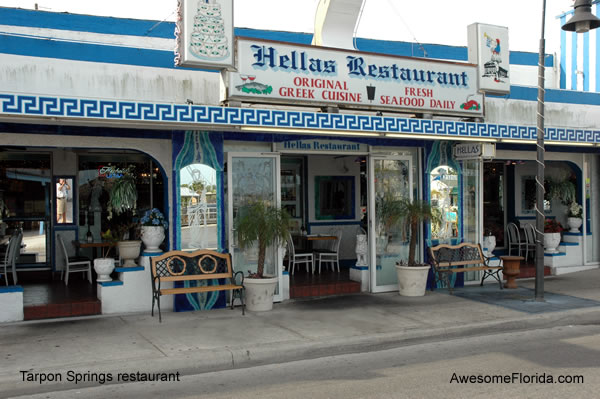
Dodecanese Blvd Restaurant
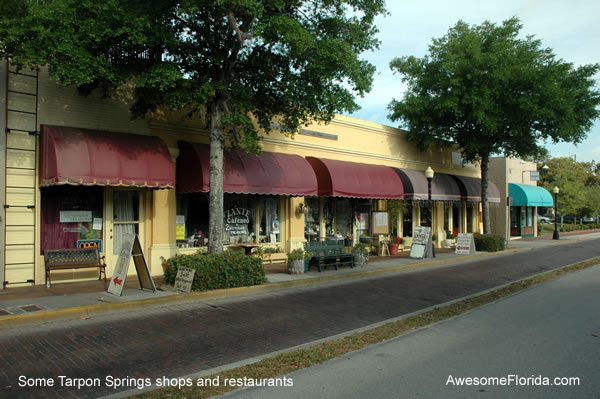
Shops and restaurants
Tarpon Avenue
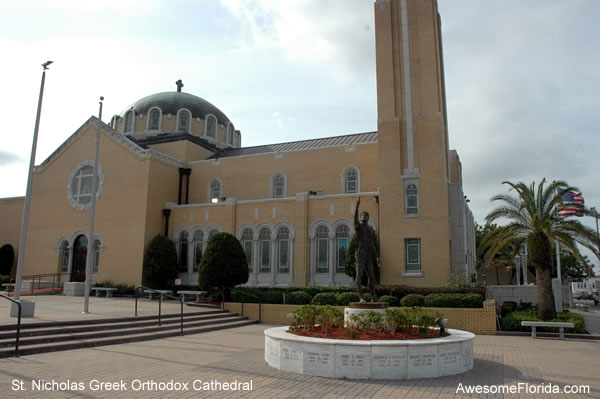
St. Nicholas Greek Orthodox Cathedral

Fishing boats

Sponges